


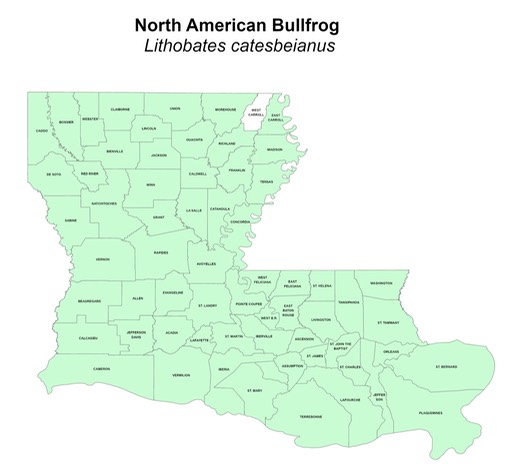
*The colored areas of the map above represent parishes with currently known records for the given species (Source: Jeff Boundy, LA Dept. of Wildlife and Fisheries). By no means does it represent the full range of the species in the state, nor does it necessarily mean that a species can be found throughout the parish with the record. This is provided as a guide to where you might be able to find these species in the state and to aid in identification. A descriptive explanation of the range of each species can be found in the text below.
Other Common Names:
Subspecies: No subspecies recognized.
Adult Description: Largest frog in Louisiana (maximum 8.7”). Olive green coloration but can be much darker. Darker individuals usually still have green heads. Often densely covered with irregular dark mottling. Skin is relatively smooth with no raised areas of skin on sides of back like North American Green Frogs, but they do have conspicuous raised skin around eardrum. Webbing of hind feet does not reach end of toes like it does in Pig Frogs. More rounded snout than Pig Frogs. Thigh is patterned but not striped like Pig Frogs. Hindlimbs with dark crossbars. Belly may be white, but many individuals have varying degrees of dark mottling present.
Similar Species:
Species Range: Throughout most of eastern United States and into extreme southeastern Canada. From Atlantic Coast west through Great Plains to Rocky Mountains but absent from south Florida and most of Minnesota westward. Introduced in many localities in western United States and elsewhere across world.
Louisiana Range: Statewide except brackish and salt marshes.
Adult Habitat: Large permanent bodies of freshwater, especially those with little or no current.
Natural History: North American Bullfrogs can be active day or night but are most active between dusk and dawn during warm, humid weather. They are indiscriminate and voracious feeders, taking any moving prey they can fit into their mouths, which includes typical arthropods, but larger individuals take fish, amphibians, reptiles, birds, and mammals. Snakes, turtles, alligators, birds, and mammals are important predators. They breed in permanent water from March to August, when females lay up to 48,000 eggs in a foamy surface film. Eggs hatch in 3–5 days and tadpoles can metamorphose in 4 months but may also overwinter and transform the following spring or summer. Maturity takes 1–2 years. Wild longevity is at least 9 years. A captive lived for nearly 16 years.
Call: A deep, resonant ‘ruummm’, sometimes stuttered, each lasting up to 1.5 seconds and often given in a series of 3–15 notes. May be given day or night.
Best Time and Place to Observe: These large frogs can easily be observed on warm spring and summer nights sitting at the edge of the permanent water bodies they inhabit. They may also be heard calling from these same areas or in the water body itself where they can be tracked down with relative ease.
Global Conservation Status: North American Bullfrogs have a relatively wide native distribution in eastern North America, a presumed large population, and tolerate a broad range of habitats, and thus, are listed as Least Concern by the IUCN Red List. Their NatureServe Global Conservation Status Rank is G5 (Secure).
Federal Conservation Status: None.
Louisiana Conservation Status: North American Bullfrogs are a game animal in Louisiana, with an unlimited legal harvest permitted in most public waters in all months except April and May with a basic fishing license. Individual American Bullfrogs, however, must be a minimum of 5 inches snout vent length when taken in public waters.
Author's Remarks: I have found this species in nearly all permanent water situations I have herped in the state either by sight or their call.
