


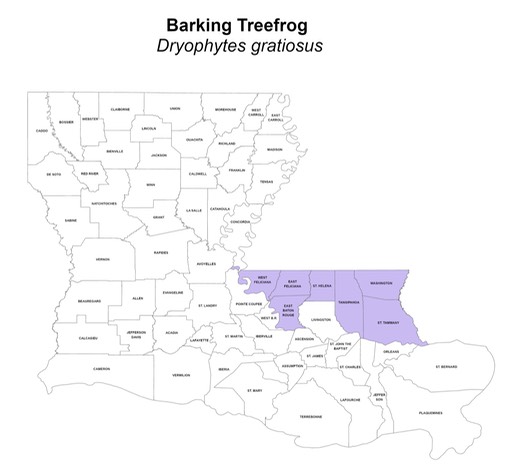
*The colored areas of the map above represent parishes with currently known records for the given species (Source: Jeff Boundy, LA Dept. of Wildlife and Fisheries). By no means does it represent the full range of the species in the state, nor does it necessarily mean that a species can be found throughout the parish with the record. This is provided as a guide to where you might be able to find these species in the state and to aid in identification. A descriptive explanation of the range of each species can be found in the text below.
Other Common Names:
Subspecies: No subspecies recognized.
Adult Description: A robust large treefrog (maximum 2.8”) with variable coloration usually bright to olive green, but sometimes gray or brown. Dorsum usually covered with profuse, circular dark markings mixed with small white or yellow spots. Expanded, adhesive toe pads used for climbing. Skin is more granular than Green or Squirrel Treefrog. A pale stripe, sometimes indistinct or incomplete, extends from upper lip down sides. Below this stripe is usually dark and white mottling. Crossbars usually present on limbs. Belly is white or yellowish white.
Similar Species:
Species Range: Primarily Coastal Plain from eastern North Carolina south to southern Florida, and west to Mississippi River in Louisiana, but also upland areas in northern Alabama and adjacent Tennessee. Isolated populations in Kentucky, Tennessee, Delaware, Maryland, and southeastern Virginia.
Louisiana Range: Florida Parishes.
Adult Habitat: Pine woodlands and mixed pine-hardwood forests.
Natural History: Barking Treefrogs are nocturnal in warm weather and spend most of their time on tree limbs and trunks, or in tree cavities, when not breeding. They likely eat a wide variety of arthropods. Predators likely include wading birds, watersnakes, and turtles. They breed from late March to mid-August in ephemeral, semi-permanent, and permanent wetlands, ponds, and ditches. Females lay 1,000–4,000 eggs. They have been reportedly laid as a surface film, singly, or in small clumps on substrate. All may be true if surface film breaks up soon after laying into small clumps, and some of these clumps further break up into single eggs as they sink onto substrate. Eggs hatch in 7 days and tadpoles metamorphose in 1.5–2 months. Maturity is likely attained in 2 years. Wild longevity is unknown, but one captive lived for 12.5 years, with averages of 7 years known.
Call: A resonant ‘tonk’ repeated about once per second. Rain calls, as opposed to advertisement calls, are repeated more slowly and irregularly, and are likened to the bark of a dog.
Best Time and Place to Observe: Listen for their distinctive vocalizations at night from spring through mid-summer near wetlands in the pinelands of St. Tammany and Washington parishes. Follow the sound of calling males to the wetland where they are often found floating at the water surface.
Global Conservation Status: Barking Treefrogs have a relatively wide distribution in the southeastern United States and a presumed large population, and thus, are listed as Least Concern by the IUCN Red List. Their NatureServe Global Conservation Status Rank is G5 (Secure).
Federal Conservation Status: None.
Louisiana Conservation Status: Barking Treefrogs do not have any special status in Louisiana.
Author's Remarks: In Louisiana, I observed this species in the wild and heard their calls in April 2021 at a site near Talisheek, and again in May 2022 at a site near Folsom. I have captured a couple individuals of this species at a site just across the Pearl River in Mississippi.
