


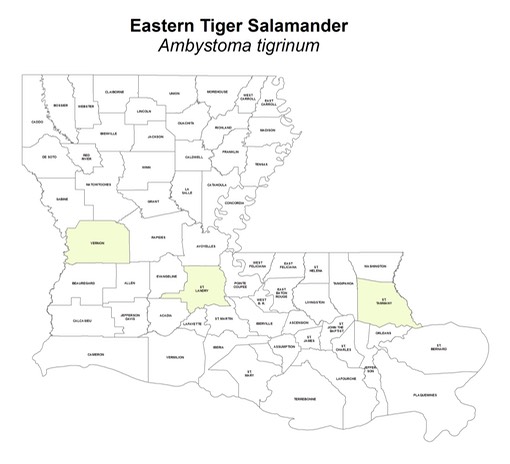
*The colored areas of the map above represent parishes with currently known records for the given species (Source: Jeff Boundy, LA Dept. of Wildlife and Fisheries). By no means does it represent the full range of the species in the state, nor does it necessarily mean that a species can be found throughout the parish with the record. This is provided as a guide to where you might be able to find these species in the state and to aid in identification. A descriptive explanation of the range of each species can be found in the text below.
Other Common Names:
Subspecies: No subspecies recognized.
Adult Description: Large, robust salamander (maximum 13”) with broad head. Black, dark gray, or brown on top with yellow or tan irregularly shaped and variably sized rounded spots extending onto sides and laterally compressed tail. Usually 12 costal grooves but range from 11–14. Belly is paler than top with yellow or tan markings, particularly at edges.
Similar Species:
Species Range: Southern New York south to northern Florida, and west from Ohio to Minnesota and southward to eastern Texas. Absent from most of Appalachia.
Louisiana Range: Known historically only from three disjunct parishes, Vernon, Caddo, and St. Tammany. Believed to persist today only in Vernon Parish.
Adult Habitat: Only known population occurs in upland pine forests near ephemeral breeding ponds with mixed pine-hardwoods. Historically this area would have been longleaf pine dominated and maintained semi-open through regular, natural fire, but area is now in pine plantation.
Natural History: Eastern Tiger Salamanders are active at night and spend most of their lives underground. They prey upon a wide variety of invertebrates and will consume small vertebrates like mice, amphibians, or reptiles given the opportunity. Poison glands on their tails may be an effective deterrent, but noted adult predators include owls, badgers, and hog-nosed snakes. In winter, Eastern Tiger Salamanders migrate overland on relatively warm rainy nights to ephemeral wetlands to breed. Total clutch size is not often reported but may be over 1,000 eggs. Females deposit eggs in many small, soft jelly egg masses attached underwater to small twigs, branches, or vegetation. Each egg mass may have 100 eggs or more, but often much less. Eggs typically hatch in 1–3 weeks and larvae may metamorphose in as little as 2.5 months, but often longer. Maturity may occur in 2–3 years. Maximum wild longevity is unknown but likely exceeds 10 years. A post-metamorph captive lived 16 years.
Best Time and Place to Observe: Take of Eastern Tiger Salamanders is prohibited in Louisiana, but most modern observations have occurred during their breeding season, either on the roads at night as the adults migrate to a breeding pond or within the breeding pond itself after they arrive.
Global Conservation Status: Eastern Tiger Salamanders have a relatively wide distribution in North America, a presumed large population, and tolerate a broad range of habitats, and thus, are listed as Least Concern by the IUCN Red List. Their NatureServe Global Conservation Status Rank is G5 (Secure).
Federal Conservation Status: None.
Louisiana Conservation Status: Eastern Tiger Salamanders have a ranking of S1 (critically imperiled because of extreme rarity – 5 or fewer known extant populations) in Louisiana. In Louisiana, Tiger Salamanders have a State Protection Status of ‘prohibited’, meaning possession or harvest of this species is illegal.
*** If you live in the range of this species in Louisiana and believe you may have observed this species please let me know (take a picture if possible), as there may be more unknown populations in the state.***
Author's Remarks: I have seen a metamorph (pictured) of this species captured from Louisiana in 2015. I photographed this same individual in captivity about a half year later. I have searched unsuccessfully on two occasions at a historic locality in Vernon Parish.
