
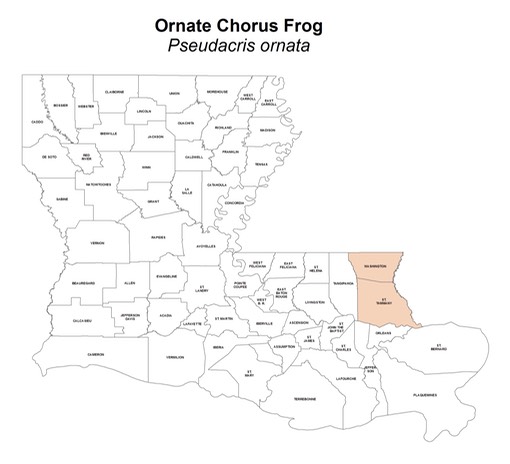
*The colored areas of the map above represent parishes with currently known records for the given species (Source: Jeff Boundy, LA Dept. of Wildlife and Fisheries). By no means does it represent the full range of the species in the state, nor does it necessarily mean that a species can be found throughout the parish with the record. This is provided as a guide to where you might be able to find these species in the state and to aid in identification. A descriptive explanation of the range of each species can be found in the text below.
Other Common Names:
Subspecies: No subspecies recognized.
Adult Description: A small, but stout, frog (maximum 1.4”) with variable coloration of gray, brown, red, or green. Dark markings on back may be present or absent, but if present, they generally consist of a dark posterior-pointed triangle between eyes, two elongate markings on either side of midline on back, and crossbars on limbs. A dark band extends from tip of snout, past eye, over forelimb, and onto side of body, but this band can be interrupted or stop completely at or near arms. Pale stripe present above dark mouth border. Forelimbs are noticeably thick for its size. Belly is white.
Similar Species:
Species Range: Coastal Plain from central North Carolina south to north Florida, and west to extreme eastern Florida Parishes of Louisiana.
Louisiana Range: Near the Pearl River in extreme eastern parts of Washington and St. Tammany in Florida Parishes.
Adult Habitat: Pine flatwoods and mixed pine-hardwood forests.
Natural History: Ornate Chorus Frogs are fossorial, spending most of their time buried under loose sandy soils. As such, they are rarely encountered when not breeding. They presumably feed upon a variety of small invertebrates. Reported predators include snakes, but also likely include birds and mammals. They breed from December to March in ephemeral vegetated ponds. Females lay up to 850 eggs in small clumps of 10–100 eggs which are attached to submerged vegetation. Eggs hatch within 7 days and tadpoles metamorphose in 3–4 months. Maturity is unknown but likely takes just 1 year. Wild longevity is unknown, but it is reported most likely don’t survive past their second breeding season. A captive lived 3.5 years.
Call: A shrill, metallic sounding ‘pip’ likened to the sound of a chisel being struck by a hammer repeated 2–3 times per second. Large choruses are likened to the sound of a rapidly turning pulley wheel badly in need of greasing.
Best Time and Place to Observe: Unfortunately, this species was last seen in Louisiana in 1954 near Pearl River in St. Tammany Parish. In areas to our east where they still occur, they are most often found when calling from their breeding habitats.
Global Conservation Status: Ornate Chorus Frogs have a relatively wide distribution in the southeastern United States, a presumed large population, and tolerate a degree of habitat modification, and thus, are listed as Least Concern by the IUCN Red List. Their NatureServe Global Conservation Status Rank is G4 (Apparently Secure).
Federal Conservation Status: None.
Louisiana Conservation Status: Ornate Chorus Frogs are considered extirpated from Louisiana and currently have a state ranking of SH (historical occurrence with no recent records verified within the last 20 years). Ornate Chorus Frogs were apparently never common in Louisiana, and their range in extreme eastern Washington and St. Tammany Parishes represented the westernmost extent of the species range. Habitat destruction resulting from urban development has been implicated in the extirpation of this species from Louisiana.
***If you live in the historical range of this species in Louisiana and believe you may have observed or heard this species please let me know (take a picture or audio recording if possible), as I hold out hope that it may be holding on somewhere unknown to authorities in Louisiana.***
Author's Remarks: I have never seen or heard this species anywhere in its range, though I have seldom herped in their historic range in Louisiana and nearly never at the right time of year to detect them.
